
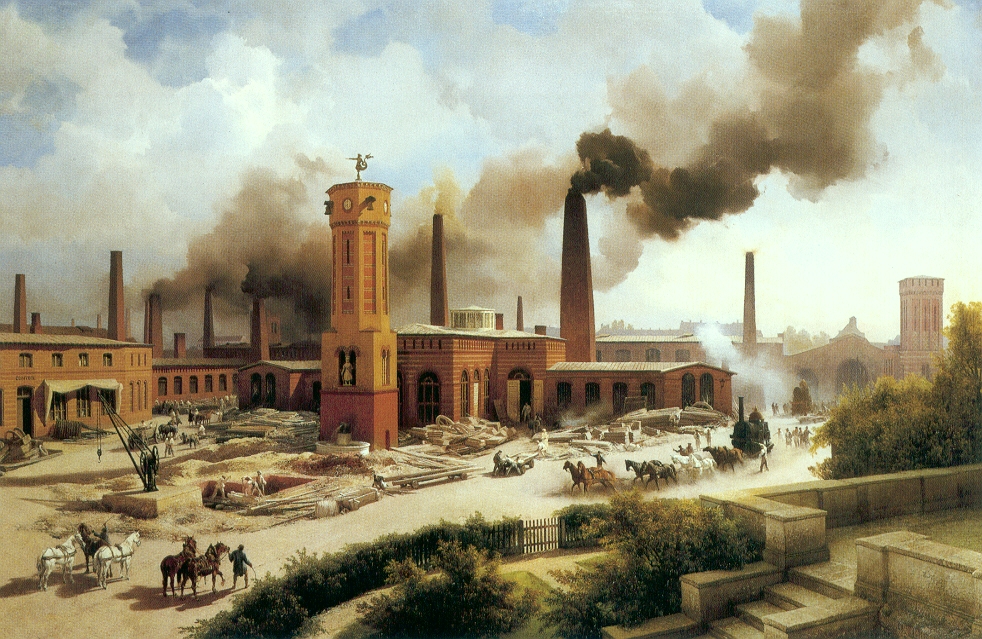
As the Industrial Revolution took full effect in Great Britain, its innovations and processes spread to the countries of the Western world, spurring technological transformations in those countries as well. One such country, Germany, was late to industrialization due to its recent unification in 1871. However, while Britain mainly developed their cotton textile industry, Germany focused heavily on large industries such as steel, coal, and chemicals. Production was facilitated largely by Cartels, businesses that cooperated to control prices and limit competition, similar to monopolies in the United States. These collaborations created concentrated capitalist structures, maintaining significant control over employment wages and conditions and leaving small businesses in ruin, leading to a rise of socialism. Nonetheless, in an environment where industry competition was at an all-time high, and labor and market rights were constantly evolving, medical policy transformed in ways that reflected these changes.
This essay will discuss the socioeconomic and political factors that led to public health policy changes in Industrial Germany. It will specifically examine the Health Insurance Bill and the Accident Insurance Bill, both implemented by Otto Von Bismarck, chancellor of the German Empire. It will demonstrate that from a socioeconomic perspective, although the policies mitigated harmful health outcomes of industrialization, they were constructed to appease blue-collar workers and incorporated fiscally unequal frameworks, sustaining and favoring operations for Cartels. From a political lens, the acts were implemented to gain support of Bismarck’s monarchy over socialism while ensuring the policies did not interfere with political will.
Up till 1883, German industries received challenges from blue-collar workers over sanitation, wages, and employment frustrations. To resist further social uprising, Bismarck implemented a series of insurance and protection policies, a strategy now labeled as “State Socialism”.1 The Health Insurance Bill introduced the world’s first compulsory health insurance, providing the workers paid sick leave and improved access to doctors,2 while the Accident Insurance Bill paid for medical treatment and gave adequate wages to disabled workers from the effects of industrialization.3 Regardless of their positive effects, the actions revealed how socioeconomic factors contributed to medical policy change. Not only was Bismarck’s intention behind the act to promote social unity among the German population, but also to protect the interests of the Cartels. If the workers continued to riot, and communism became an ingrained belief among the people, then the capitalist economy of his nation would collapse. Thus, these policies did not truly intend to better the lives of the German people, but rather acted as a socioeconomic tool to appease blue-collar workers and serve the interests of industrial enterprises. Yet what further demonstrates that Bismarck’s actions were agenda-based is found in the fiscal management of the policies’ budgets. For instance, when inspecting the industrial healthcare system, one-third of the financing came from employers while the rest from the workers themselves.4 This allocation displayed socioeconomic influences. Bismarck’s action of establishing a program that supposedly relieved industrial burdens showed the worker population that their needs were accounted for, thus easing their social dissatisfaction. However, the system truly ensured that Cartels would not lose a workforce, sustaining their business at a minimal expense while workers faced greater debt than their employers. Therefore, in Industrial Germany, social tensions from workers led to their conciliation through policies which, on a superficial level, alleviated harmful effects of industrialization, but they were truly financially inequitable and burdened the blue-collar population while supporting industry.
Yet health policy in Industrial Germany must be viewed through a political lens, as when socialist-led riots emerged in the Bismarckian era, their purpose was not only to urge for industrial reform, but also to revise the existing social order and constitutional monarchy.5 In response, Bismarck established the Anti-Socialist laws, policies that prohibited socialist, social democratic, and communist associations and meetings,6 protecting his rule and state authority. His desires to regulate and undercut marxist sentiments were captured in an 1884 message:
Dissatisfied workers are just what they [Social Democratic leaders] need. Their mission is to lead, to rule, and the necessary prerequisite for that is numerous dissatisfied classes. They must naturally oppose any attempt of the government, however well intentioned it may be, to remedy this situation, if they do not wish to lose control over the masses they mislead.7
Although Bismarck acknowledges the party to occasionally have positive intentions, he portrays them as oppressive, claiming that Social Democrats must attack any government, solely representing workers for gaining power and rule. Regardless of the accusation’s truth, however, by characterizing the Social Democratic Party as a radical, exploitative movement, it becomes clear how political agenda influenced medical policy change in Industrial Germany. For example, the policies mentioned earlier, such as the Health and Accident Insurance Bills, though they burdened the blue-collar population, would have maintained Bismarck’s authority and legitimized his power. The acts’ intentions were to demonstrate that the state would care for the unfortunate, so radical changes and complete upheaval of existing orders were unnecessary. Thus, health policy change in Industrial Germany occurred to emphasize the current political authority and promote its superiority over Marxism. Yet ambitions of the crown also influenced such change. During Bismarck’s rule, Western nations competed to colonize and establish imperial rule, not only fueling Industrialization but also emphasizing national superiority. Consequently, when constructing the funding for the new healthcare system to be paid by majority blue-collar workers, he ensured that no costs would burden the imperial budget.8 Such an action displays the extent to which Bismarck valued political goals over humanitarian concerns, as the welfare system’s design did not purposefully interfere with the government’s desire to expand empire, revealing that nationalist and state concerns were valued over the well-being of the population. Although the insurance would protect workers from harmful outcomes, the purposeful cost allocation to not interfere with imperialist spending influenced medical policy in Industrial Germany in a way that resolved internal political needs while ensuring external will was preserved.
Overall, socioeconomically, Bismarckian policies supported businesses and Cartels over workers, as although they provided treatment for injuries from industry, they were only meant to subdue the worker population and relied on economically unequal designs. Politically, to protect the constitutional monarchy from socialism, Bismarck implemented the policies to gain favor for his regime while protecting political will.
Notes
- Vernon L. Lidtke, “German Social Democracy and German State Socialism, 1876–1884,” International Review of Social History 9, no. 2 (1964): 202-205, https://www.jstor.org/stable/44583622.
- Reinhard Busse et al., “Statutory Health Insurance in Germany: A Health System Shaped by 135 Years of Solidarity, Self-governance, and Competition,” The Lancet 390, no. 10097 (2017), under “From cash benefits to services-in-kind,” https://doi.org/10.1016/s0140-6736(17)31280-1.
- Timothy Guinnane and Jochen Streb, Incentives That Saved Lives: Government Regulation of Accident Insurance Associations in Germany, 1884–1914 (RWI, 2012), 10, https://doi.org/10.4419/86788418.
- Stefan Bauernschuster et al., “Bismarck’s Health Insurance and the Mortality Decline,” Journal of the European Economic Association 18, no. 5 (2019): 8, https://doi.org/10.1093/jeea/jvz052.
- Julius Braunthal, The History of the International: Volume I, 1864–1914 (New York: Frederick A. Praeger, 1966), chap. 18.
- Law against the Publicly Dangerous Endeavors of Social Democracy (October 21, 1878),” German History in Documents and Images, German Historical Institute, https://ghdi.ghi-dc.org/sub_document.cfm?document_id=1843.
- Otto von Bismarck, “Reichstag Speech on the Law for Workmen’s Compensation,” March 15, 1884, in Forging an Empire: Bismarckian Germany, 1866–1890, vol. 4, Bismarck’s Reichstag Speech on the Law for Workmen’s Compensation, 72–78, German History in Documents and Images, https://germanhistorydocs.ghi-dc.org/pdf/eng/429_BismarckerWorker%27s%20Comp_130.pdf.
- Anastasia Driva, Erik Hornung, and Stefan Bauernschuster, “Bismarck’s Health Insurance and its Impact on Mortality,” VoxEU CEPR, October 7, 2017, accessed July 22, 2025, https://cepr.org/voxeu/columns/bismarcks-health-insurance-and-its-impact-mortality.
 Global Histories of Health
Leave a comment